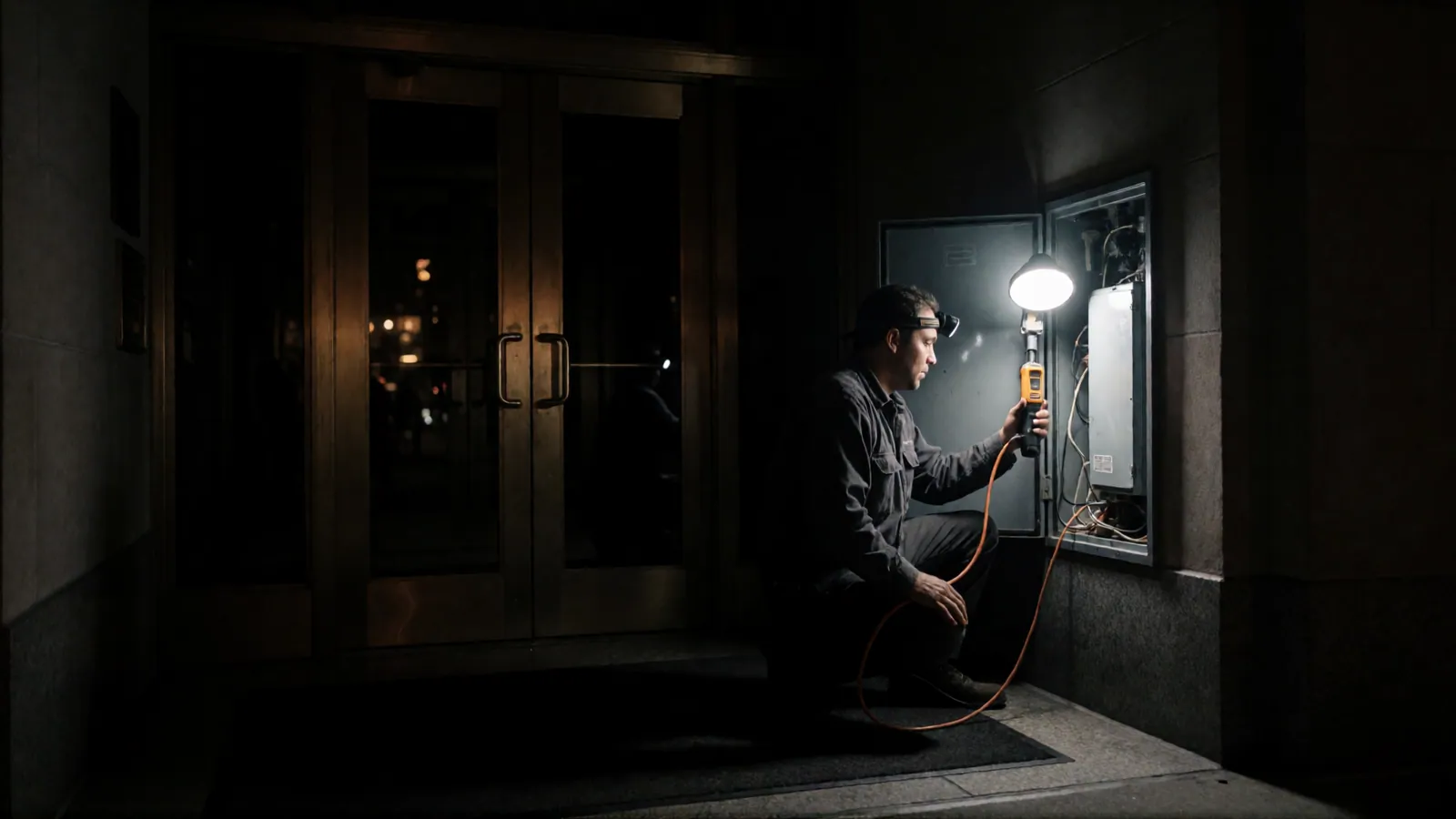
Some of this is not our job, and saying so matters
Before we arrive
There are situations where telephoning an electrician first costs you time you may not have. This page is the list, and it is deliberately the first thing on it — ahead of anything we would like to sell you.
Call the fire department, not an electrician, if you can smell burning and cannot account for it, or if there is smoke or flame. Leave the building first and telephone from outside. Do not go looking for the source, and do not open a panel. Nothing electrical in a building is worth being inside it for.
Call somebody other than us
A downed or arcing power line outside. Con Edison, and 911 if anybody could come near it. Stay well back, and keep people and animals away from anything touching it — fences, vehicles, standing water. The ground near an energised conductor can itself be dangerous, which is not intuitive and is why the distance matters.
Burning, smoke or flame. Leave, then call the fire department. Every year somebody dies in a building they stayed in to investigate a smell.
A smell of gas. Leave immediately and call the gas utility from outside. Do not operate any switch on your way out, including a light switch, a doorbell or an electric garage door — a switch makes a small spark every time it is used.
Somebody in contact with electricity. Do not touch them. Call 911, and disconnect the supply only if you can reach a switch or the panel safely.
The whole street is dark. That is a utility outage. There is nothing on your side of the meter to repair and nothing we can usefully do.
Things that are ours, and are urgent
A burning or fishy smell that you have traced with confidence to a panel, an outlet or a switch, in a building with no smoke. Sparking or arcing inside the building. Discolouration or scorching around a device. A panel that is warm to the touch, buzzing or humming. Water that has reached electrical equipment. A shock or a persistent tingle from an appliance, a tap or a metal fitting — which very often means a bonding problem and should not be lived with.
Things that are ours, and can usually wait until morning
A dead circuit in a building that is otherwise fine. A breaker that will not reset. An outlet that has stopped working. Flickering with no smell and no heat. A light fitting that has failed.
If you can identify the circuit and switch it off at the panel safely, an isolated circuit is a safe circuit and there is no penalty for waiting. We would rather tell you that at eleven at night and see you at eight in the morning than charge you an emergency rate for something that was never an emergency.
What we will not do on the telephone
Talk you through repairing it yourself. That is not a commercial position — it is that the difference between switching a circuit off and knowing it is off is the entire safety margin in this trade, and it is not something anybody can transfer over a telephone to somebody without a tester in their hand.
Switching a circuit off at the panel is a reasonable thing to do if you can identify it and reach the panel safely. Opening anything up, testing anything, or working on a circuit you believe to be dead is not, and we will say so rather than being agreeable.
No instructions here, and here is why. You will not find step-by-step instructions on this website for working on your own electrical system, and that is deliberate. The hazard in this trade is not that the work is difficult; it is that the circuit is still live, or that the thing you switched off is not the thing you are touching. Turning power off at a panel and proving it is off are two different acts, and the second one is what keeps people alive. We are glad to explain what we are doing, and why, while we do it.
While you wait
Useful things to do before we get there
- If you can identify the affected circuit and reach the panel safely, switch it off — an isolated circuit is a safe circuit.
- Unplug what was connected to it, particularly anything that had been running hot.
- Keep people and pets away from the area, and out of any standing water near equipment.
- Note what happened and when, and what was running at the time. It is genuinely the most useful thing you can give us.
- Clear a path to the panel. In a Queens basement this is frequently the slowest part of the visit.
- Find a torch. If the power is off, the panel is usually in the darkest room in the house.
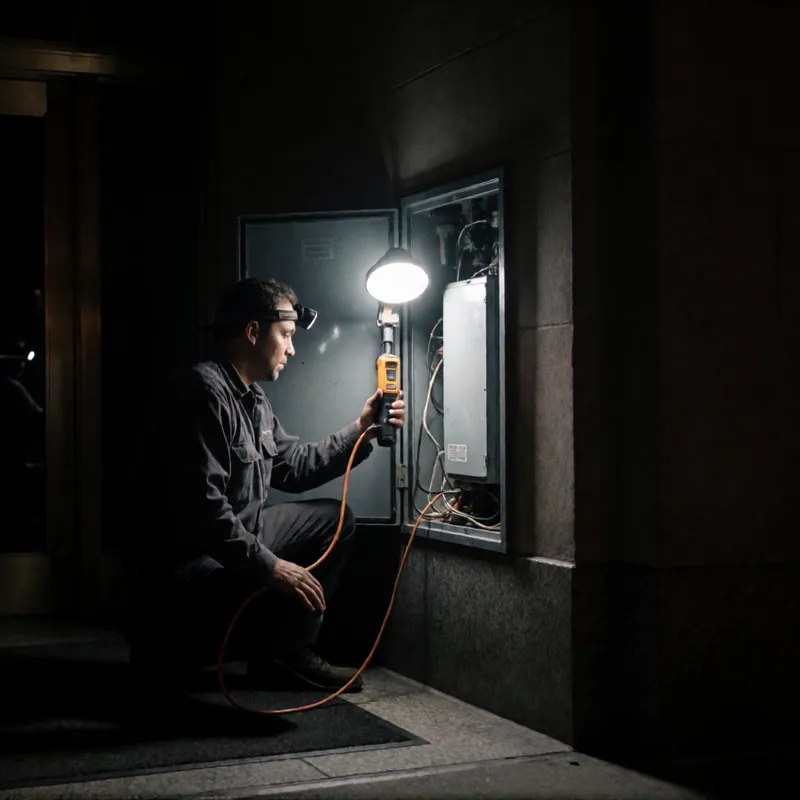
A real person, and a real time. Somebody on this crew carries the on-call telephone every night of the year, and it is answered by an electrician rather than by an answering service. That is not the same as promising to be at your door in twenty minutes, and we will not print a number of minutes we cannot keep. What you will get is a real person, an honest answer about when we can be there, and — if the safe thing is to call the utility or the fire department instead of us — that answer instead, immediately and at no charge.
Questions people actually ask
Electrical emergencies — frequently asked
I can smell burning. What do I do?
If you cannot immediately and confidently identify a harmless source, leave the building and call the fire department. Do not go looking for it, do not open a panel, and do not wait for an electrician. Once you are outside and safe, telephone us — but the order matters and it is not negotiable.
The whole street is dark. Should I call you?
No — that is a utility outage and there is nothing on your side of the meter to repair. Report it to Con Edison. If your house is dark and your neighbours are not, that is more likely to be yours, and that one is ours.
There is a downed wire outside. Who do I call?
Con Edison, and 911 if anyone could come near it. Stay well back and keep everybody away from anything touching it, including fences, vehicles and standing water — energised conductors can make the ground around them dangerous. This is not an electrician's job and calling us first only costs you time.
Someone has had a shock. What now?
Do not touch them if there is any chance they are still in contact with the source. Call 911. If it is safe to reach the panel or a switch, disconnect the supply. Anybody who has taken a shock across the body should be seen by a doctor even if they feel fine afterwards, because some effects are not immediately obvious.
Water has come into contact with electrical equipment. Is that urgent?
Yes, and treat it as one. Do not touch the equipment and do not stand in the water to reach a switch. If the panel is somewhere safe and dry to reach, switching off is worth doing; if there is any doubt at all, telephone us or the utility and wait outside the affected area.
Can I just switch the circuit off and deal with it tomorrow?
Often yes, and that is frequently our own advice on the telephone — an isolated circuit is a safe circuit, and a great many faults can honestly wait until morning. What must not wait is anything involving a smell of burning, smoke, arcing, heat at the panel, or water in electrical equipment.
An electrician answers, every night
Telephone us
$285 covers the first hour outside working hours, and you are told that number before anybody sets off. If the right answer turns out to be the fire department or Con Edison, we will tell you that immediately and there is no charge for it — there never will be.