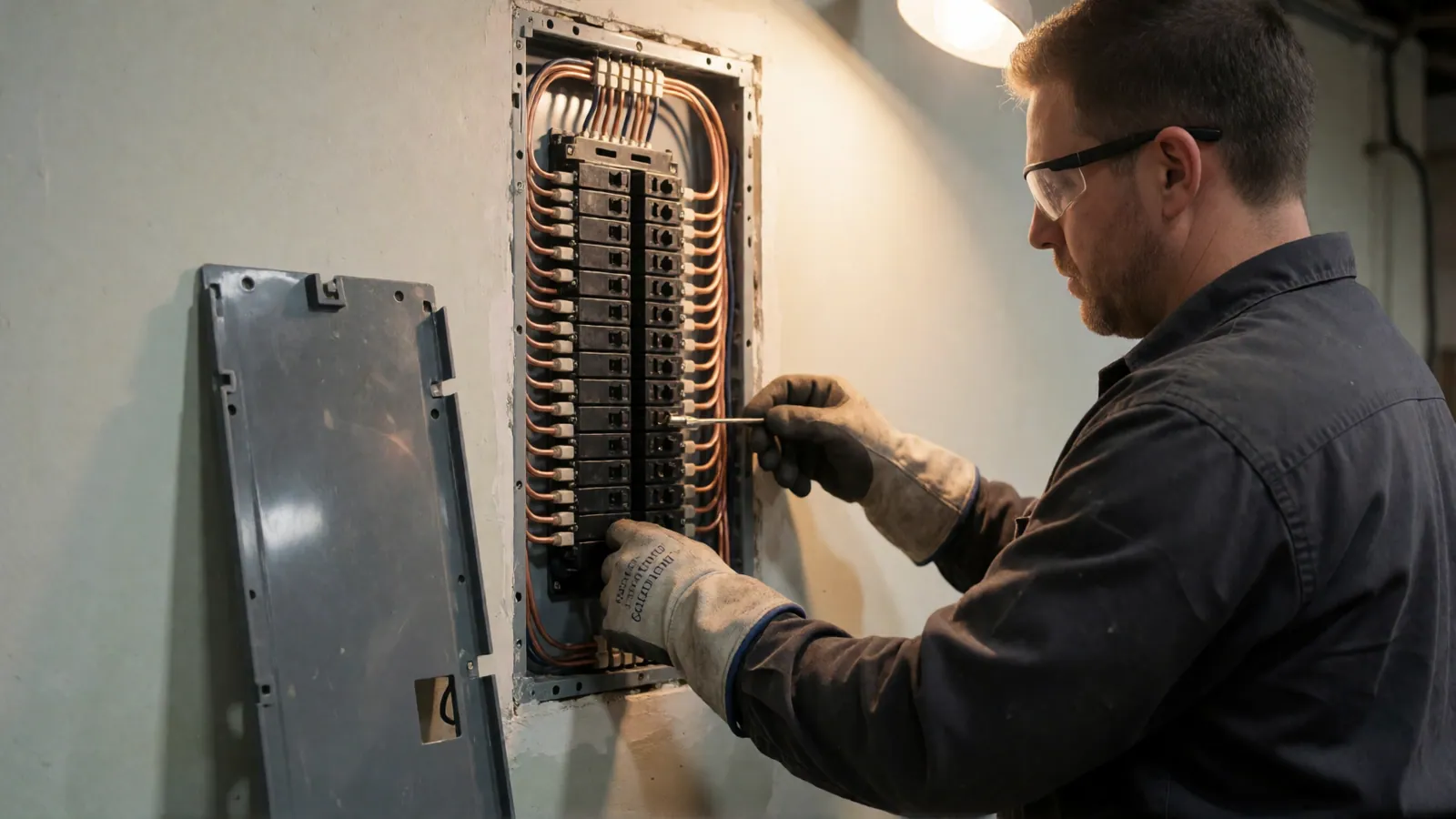
Where the evidence stops and the sales pitch starts
Is your old panel dangerous?
Some old panels really are a documented hazard. Most old panels are simply old. This trade has a strong commercial reason not to distinguish between the two, so here is the distinction in full.
We do not sell panels on fear. An old panel is not automatically a dangerous panel. Two specific makes — Federal Pacific Stab-Lok and Zinsco — have a documented history of breakers that fail to trip on an overload, and we will recommend replacing those on the evidence. A sound forty-year-old panel from a maker with no such history is a different conversation, and so is aluminium branch wiring, which the Consumer Product Safety Commission says can be permanently repaired at the connections rather than torn out. Nobody here will tell you your house is about to burn down in order to sell you a panel. If we recommend a replacement we will give you the specific reason, show you the thing we are talking about, and put it in writing.
The two makes where the concern is documented
Federal Pacific Electric Stab-Lok and Zinsco panels are the genuine cases, and it is worth understanding why rather than taking anybody's word for it.
For Stab-Lok, the concern is breakers that fail to trip on an overload. Independent testing over several decades has repeatedly found failure rates far above what the standards contemplate, the Consumer Product Safety Commission opened an investigation in 1980 after reports connected the panels to fires, and in 2005 a New Jersey court found the manufacturer had misrepresented that the breakers met safety standards. For Zinsco the mechanism is different — degradation at the connection between the breaker and the busbar — but the outcome is the same category of failure.
The reason this matters more than an ordinary defect is that the failure is latent. The panel distributes power flawlessly for forty years. Nothing about its daily behaviour tells you anything at all about whether it will open on the one occasion it is asked to. So “it has been fine since 1974” is not evidence, and that is genuinely unusual — for most things in a building, decades of good service is exactly the evidence you would want.
What is not evidence that a panel is dangerous
That it is old. That the brand is one you have not heard of. That it has fuses rather than breakers — a fuse is a perfectly effective overcurrent device, and its real drawbacks are capacity and the temptation to fit the wrong size, not a defect. That somebody said so on a doorstep, in a photograph, or over the telephone without having seen it.
We are not claiming this trade is uniquely dishonest. We are claiming that the incentive here is unusually clean: a panel replacement is a well-defined, several-thousand-dollar job that almost any homeowner can be persuaded to fear, and the thing being feared cannot be disproved by anything the homeowner can observe. That combination is worth being alert to.
The four honest reasons to replace one
A documented defect in the specific make. Physical condition — corrosion, water tracking, heat damage at terminations, an arced busbar, or a cabinet cut about too many times to close properly. Capacity — no spaces left, and workarounds inside that are themselves a problem. Or you are doing something else anyway, and the panel is a sensible increment on a job already happening.
If none of those apply, our recommendation will be to leave it alone, have the terminations checked and torqued, and spend the money on your grounding and bonding instead — which in most Woodside houses is a far larger real-world safety improvement for a fraction of the cost.
Aluminium wiring, which is a different argument
Solid aluminium branch circuits from the late 1960s and early 1970s are a real hazard, and the hazard is at the terminations rather than in the middle of the run. The Consumer Product Safety Commission accepts comprehensive repair at every accessible connection — pigtailing to copper with an approved connector — as a permanent repair, alongside complete replacement.
That matters because the pitch you will usually hear is a whole-house rewire. Sometimes that genuinely is the right answer. Often it is several times the cost of a repair the CPSC itself considers permanent. Note also that large aluminium conductors in a service entrance or a feeder are entirely normal and current practice, and are not what any of this is about — a great deal of unnecessary alarm comes from confusing the two.
How to test what you are being told
Four questions worth asking anybody who quotes you a panel
“Which make is it?”
A specific answer means they have looked. If the concern is a documented defect, they will name the make without being prompted.
“Show me.”
Heat damage, corrosion, an arced bus or a double-tapped lug can be pointed at. A hazard nobody can show you is a hazard worth a second opinion.
“What does the load calculation say?”
If the recommendation is a bigger service, there should be arithmetic behind it. If there is not, that is the whole answer.
“Put the reason in writing.”
Not the price — the reason. Almost nobody who is inventing a hazard will write it down.
Questions people actually ask
Old panels — frequently asked
Is a Federal Pacific panel really dangerous?
The concern is documented rather than invented. Independent testing and litigation have found that a meaningful share of Stab-Lok breakers fail to trip under overload conditions, and a New Jersey court found in 2005 that the manufacturer had misrepresented compliance with safety standards. What makes it serious is that the failure is latent: the panel behaves perfectly every day and fails only at the moment it is called on. Years of quiet service are not evidence that the protection works. We recommend replacing these, and we will show you the panel and say why.
What about Zinsco?
Similar picture, different mechanism — the failures are associated with the breaker-to-bus connection degrading, which can leave a breaker unable to interrupt properly. Same recommendation, same reasoning, and the same insistence on showing you the actual equipment rather than a stock photograph on a leaflet.
My panel is forty years old. Should I replace it?
Not on age alone. A sound panel from a maker with no documented defect history, in a dry location, with terminations in good condition and enough capacity for the house, can carry on. What it deserves is a proper look: torquing, thermal check, and an honest conversation about capacity. If we find nothing, we will tell you so and you will have spent the price of an inspection rather than the price of a panel.
Someone told me my panel is a fire waiting to happen. Is it?
Ask them which make it is and what specifically they are pointing at. There are real answers to that question — a documented defect, visible heat damage, corrosion, an arced busbar, double-tapped lugs — and if they can give you one, listen. If the answer is vague or is about age alone, you are being sold something, and a second opinion is worth $385.
Do I need to replace my panel if I have aluminium wiring?
Usually not for that reason. Aluminium branch circuits are a connection problem, and the Consumer Product Safety Commission accepts permanent repair at those connections as an alternative to replacement. That is a different, much cheaper job than a panel. The two get bundled together in sales conversations far more often than the evidence supports.
Will my insurer make me replace it?
Some insurers do ask about specific panel makes, and a few will decline or surcharge over them. That is a real commercial pressure and it is a legitimate reason to replace one. It is a different reason from the safety case, though, and we think you should know which of the two is actually driving the decision you are making.
Somebody has quoted you a panel
Get a second opinion for $385
A written inspection report on what is actually there, what condition it is in, and whether the recommendation you have been given is supported. If the first contractor was right, we will say so plainly — that happens, and the report is worth having either way.